
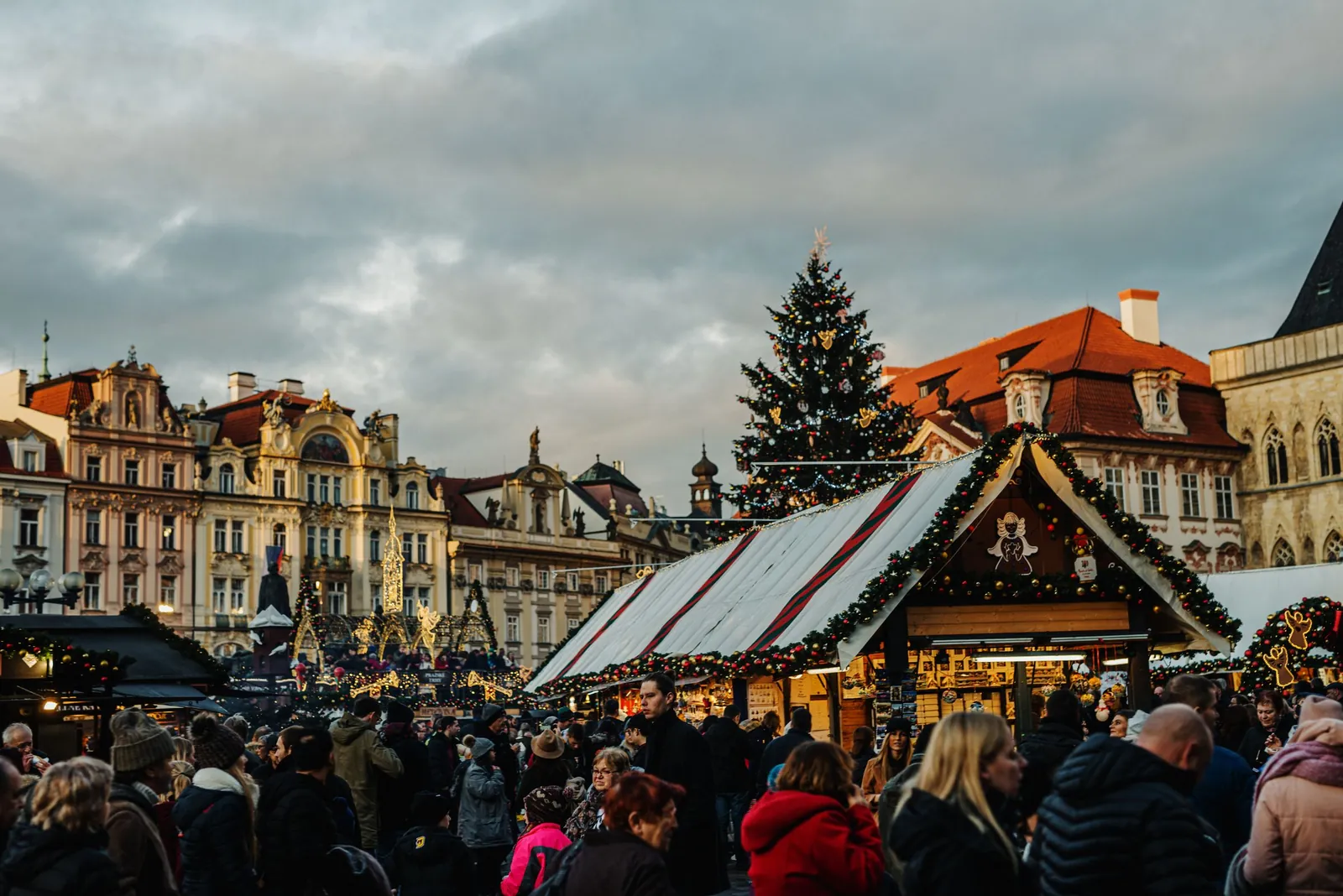
It's 4:30 on a December afternoon, the sky has already gone navy, and a square full of wooden huts flickers on at once. Someone hands you a steaming mug of mulled wine, a brass band starts up under a cathedral, and the whole place smells of roasted almonds and woodsmoke. That moment is why people cross an ocean for a week of cold feet.
The hard part is choosing. There are thousands of markets across the continent, they open and close on different days, and the famous ones get so crowded on Advent Saturdays that you can spend an hour moving fifty yards. This guide picks the best Christmas markets in Europe for 2026, gives you the dates and the one thing to eat at each, and then shows you how to string several together by train without wasting a day.
Quick answer: The best Christmas markets in Europe for 2026 are Nuremberg, Vienna, Strasbourg, Prague, Dresden, Colmar and Cologne, with Budapest, Munich, Basel and Brussels close behind. Most open between mid November and the week before the first Advent Sunday (November 29, 2026) and close on December 23 or 24, so plan your trip for late November or the first two weeks of December, and visit on weekdays if you can.
The best Christmas markets in Europe for 2026
Dates below come from official city or tourism listings where they were published by late October 2026. Where a market had not confirmed its dates, we say so. Always check the official site before you book, because hours shift and individual markets inside a city often run on different schedules.
Nuremberg, Germany: the benchmark
- Best for: the classic German market, done properly. The Christkindlesmarkt on the Hauptmarkt is strict about tradition, so stalls sell handmade goods rather than plastic tinsel.
- 2026 dates: November 27 to December 24, per the City of Nuremberg. It opens with the Christkind's prologue from the Frauenkirche balcony on the evening of November 27.
- Eat and drink: three Nürnberger Rostbratwürste in a bun ("Drei im Weggla") and Lebkuchen, the city's soft gingerbread. Look for the prune figures called Zwetschgenmännle.
- Crowd tip: opening night and Saturdays are packed. Come at 10:00 on a weekday and you'll have room to browse.
Vienna, Austria: the most elegant
- Best for: a city with a market on almost every square. The main Vienna Christmas market fills Rathausplatz in front of the neo-Gothic City Hall, with lit trees and an ice rink next door.
- 2026 dates: November 13 to December 26, daily 10:00 to 22:00, closing at 18:30 on December 24 (official site). Schönbrunn Palace's market runs longer, into early January.
- Eat and drink: Punsch (fruit punch, often with rum) instead of Glühwein, plus Maroni (roast chestnuts) and Kaiserschmarrn.
- Crowd tip: Rathausplatz is the busiest. For a calmer mood, try Spittelberg's lanes or the Belvedere. Our Vienna destination guide maps the sights between them.
Strasbourg, France: the "Capital of Christmas"
- Best for: scale. The Christkindelsmärik dates to 1570 and spreads across a dozen squares on the Grande Île, with Place Broglie as its historic heart.
- 2026 dates: not confirmed by late October. It typically opens in the last week of November and runs to December 24; check the official Strasbourg tourism site.
- Eat and drink: vin chaud (white or red), bredele biscuits and a slice of kougelhopf.
- Crowd tip: weekends get security checkpoints and long lines on the bridges into the old town. Arrive before 11:00 or stay for a late weekday evening.
Prague, Czechia: the fairy-tale square
- Best for: the view. The Old Town Square market sits between the Týn Church spires and the Astronomical Clock, with a huge tree in the middle.
- 2026 dates: widely listed for November 28, 2026 to January 6, 2027, though we had not seen city confirmation by late October.
- Eat and drink: trdelník is more tourist invention than tradition; try svařák (mulled wine) and grilled klobása instead.
- Crowd tip: Wenceslas Square and Náměstí Míru are quieter and a little cheaper. Plan the rest of your days with our Prague destination guide.
Dresden, Germany: the oldest
- Best for: history and Stollen. The Striezelmarkt has been running since 1434, which makes it one of Germany's oldest.
- 2026 dates: listed for November 25 to December 24. The Stollenfest parade is usually held on the Saturday before the second Advent Sunday.
- Eat and drink: Dresdner Christstollen, the fruit bread the market is named after, and Pflaumentoffel figures.
- Crowd tip: Dresden has around ten markets; the Augustusmarkt and the medieval market at the Stallhof are good escapes.
Colmar, France: the prettiest town
- Best for: half-timbered houses, canals and six small markets you can walk between in an afternoon.
- 2026 dates: listed for November 23 to December 29, with the gourmet market staying open a few days longer.
- Eat and drink: flammekueche (Alsatian tarte flambée) and a glass of Alsatian white vin chaud.
- Crowd tip: tour buses arrive late morning. Stay overnight and walk Little Venice after 18:00.
Cologne, Germany: the cathedral backdrop
- Best for: the twin spires. The market on Roncalliplatz sits right under Cologne Cathedral.
- 2026 dates: listed for November 16 to December 23. Cologne runs several other markets, including the Heumarkt and the Harbour market by the Chocolate Museum.
- Eat and drink: Reibekuchen (potato pancakes with apple sauce) and a mug of Glühwein.
- Crowd tip: the city is a big weekend magnet for travelers from the Netherlands and Belgium, so visit Monday to Thursday.
Budapest, Hungary: the best food
- Best for: eating. Stalls serve proper hot meals, not just snacks.
- 2026 dates: the Vörösmarty Square market is widely listed as opening November 13 and running to December 31; the St. Stephen's Basilica market typically runs to January 1. Check before you go.
- Eat and drink: kürtőskalács (chimney cake), lángos and töltött káposzta (stuffed cabbage).
- Crowd tip: the Basilica's light show on the facade draws the biggest crowds after dark. Watch it, then eat at Vörösmarty.
Munich, Germany: the big-city market
- Best for: atmosphere around the Neues Rathaus. The Munich Christmas market on Marienplatz is the city's oldest.
- 2026 dates: November 20 to December 24, per the city listing.
- Eat and drink: Feuerzangenbowle (rum-soaked sugar set alight over mulled wine) and Bavarian Weisswurst for lunch.
- Crowd tip: don't miss the Kripperlmarkt for nativity figures, or the Medieval Market at Wittelsbacherplatz.
Rothenburg ob der Tauber, Germany: the walled town
- Best for: a medieval town that feels built for December.
- 2026 dates: listed for November 20 to December 23, closed on November 22.
- Eat and drink: Schneeballen, crumbly pastry balls dusted with sugar.
- Crowd tip: day-trippers leave by 17:00. Sleep inside the walls and you get the lantern-lit lanes almost to yourself.
Basel, Switzerland: the calm alternative
- Best for: a refined, uncrowded market on two squares, Barfüsserplatz and Münsterplatz.
- 2026 dates: November 26 to December 23, daily 11:00 to 20:30, per Basel Tourism, with earlier closing on December 23.
- Eat and drink: Basler Läckerli (spiced honey biscuits) and Glühwein in Swiss prices.
- Crowd tip: an easy add-on from Colmar, and quieter than Alsace on a Saturday.
Brussels, Belgium: the light show
- Best for: a long-running festival. Winter Wonders spreads from the Bourse to the Place Sainte-Catherine.
- 2026 dates: November 27, 2026 to January 3, 2027 (official).
- Eat and drink: fresh waffles, oysters with white wine at Sainte-Catherine, and Belgian beer at the stalls.
- Crowd tip: the Grand-Place light show runs on repeat in the evening, so you don't need to fight for the first one.
Salzburg and Aachen: two short detours
- Salzburg's Christkindlmarkt on Domplatz typically opens in late November and runs to January 1. Pair it with Vienna on the same train line.
- Aachen's market around the cathedral and town hall typically runs to December 23. Buy Aachener Printen, a hard spiced gingerbread, and pair it with Cologne.
Christmas markets in Germany: the classic route
If you only have time for one country, make it Germany. The density is unmatched: almost every town of any size has a market, and the regional trains link them. Many traditional Christmas markets in Germany open the Monday after Totensonntag (November 23 in 2026), though Munich and Cologne open earlier.
Three German routes work especially well:
- Bavaria and Franconia (4 to 5 days): Munich to Nuremberg is roughly 1 hour 15 minutes by ICE. From Nuremberg, Rothenburg is roughly 1.5 to 2 hours by regional train with a change. Add Regensburg or Bamberg if you have a spare afternoon.
- Rhineland (3 days): Cologne to Aachen is roughly 40 minutes to an hour by train, and Düsseldorf is under half an hour from Cologne. Base yourself in Cologne and day-trip.
- Saxony (2 to 3 days): Dresden, plus Leipzig, roughly 1.5 hours away by train.
How to plan a Christmas market trip
Combine cities into one route
The smartest market trips follow a rail line, not a wish list. A few proven combinations:
- Vienna, Prague and Budapest (6 to 8 days): Vienna to Budapest is roughly 2.5 hours by train, and Vienna to Prague roughly 4 hours. A loop of Budapest, Vienna, then Prague avoids backtracking.
- Strasbourg, Colmar and Basel (4 days): Strasbourg to Colmar is roughly 30 minutes by TER regional train, and Colmar to Basel roughly 45 minutes. Add a day in the Black Forest from Freiburg if you want snow and fir trees.
- Munich, Salzburg and Vienna (5 days): one rail corridor with three very different markets.
How many markets per day
A realistic pace is one big market and one or two small ones per day. Markets come alive after dark, which in December means from about 16:00, so use daylight for museums or sights and spend evenings at the stalls.
- Long weekend (3 days): one city with several markets, or two cities a short train ride apart (Strasbourg and Colmar, Cologne and Aachen).
- One week: three cities, with at least two nights in each. Changing hotels every night eats the hours you came for.
This is where a planner helps. Type "five days, Vienna and Prague, Christmas markets, by train" into Atlazi and you get a day-by-day plan with real stops, ordered so a day's markets and sights sit in a sensible sequence with estimated travel time between them. Want to swap the Belvedere for Schönbrunn? Edit the day by hand, or ask the assistant to change it and review the exact diff before you accept.
When European Christmas markets open in 2026
Dates to know
- First Advent Sunday: November 29, 2026.
- Early openers: Vienna and Budapest (November 13), Cologne (November 16), Munich and Rothenburg (November 20).
- Many German markets: from November 23, after Totensonntag.
- Nuremberg and Brussels: November 27.
- Last days: many German and Swiss markets close on December 23 or at lunchtime on December 24. Vienna's Rathausplatz runs to December 26; Prague, Budapest and Brussels continue into the new year.
Weekdays vs Advent weekends
The four Advent weekends (from November 28 to December 20 in 2026) bring the biggest crowds, especially Saturdays. Monday to Thursday evenings are noticeably calmer. Late November is the sweet spot: almost everything is open, hotels are often cheaper than in mid December, and crowds haven't peaked.
Opening hours
Most markets open around 10:00 or 11:00 and close between 20:00 and 22:00. Some German markets close on Totensonntag (November 22), so check if your trip includes it.
Budget and practical tips
What things cost (examples)
Prices vary by city and rise every year, so treat these as rough examples from recent seasons:
- Mulled wine: roughly 4 to 6 euros a cup in Germany and Austria, more in Switzerland, and often a little less in Alsace.
- A sausage or hot snack: roughly 4 to 8 euros.
The cup deposit
In Germany, Austria and Alsace your drink usually comes in a ceramic or reusable mug with a deposit (Pfand), often a few euros. Return it to any stall of the same market for a refund, or keep it as a souvenir; designs change by market and often by year.
Cash vs card
Cards and phone payments are widely accepted at the big markets now, but smaller stalls and village markets may still prefer cash. Carry a small amount of local currency, which means euros in most places, koruna in Prague, forint in Budapest and Swiss francs in Basel. Prague and Budapest stalls sometimes quote euros at a poor rate, so pay in local currency.
What to wear and pack
You'll stand still outdoors for hours, which is colder than walking. Pack:
- Thermal base layers and wool socks
- Waterproof boots with grip for cobblestones and wet slush
- Gloves thin enough to hold a mug, a hat and a scarf
- A small crossbody bag with a zip, since crowded markets attract pickpockets
- A tote for gingerbread, ornaments and that collectible mug
Atlazi's packing list adjusts to your trip length and the forecast for your dates, which helps if Basel turns out mild and Dresden turns out freezing.
Frequently asked questions
Which country has the best Christmas markets in Europe? Germany has the most and the most traditional, with Nuremberg, Dresden and Cologne at the top. Austria (Vienna, Salzburg) and Alsace in France (Strasbourg, Colmar) are close rivals.
When is the best time to visit European Christmas markets in 2026? Late November to mid December, ideally on weekdays. Most markets are open from the first Advent weekend (November 28 to 29) until December 23.
Are Christmas markets open on Christmas Day? Most German markets are closed by then; many close on December 23 or at midday on December 24. Vienna's Rathausplatz, Prague, Budapest and Brussels stay open past Christmas.
How many Christmas markets can you see in one trip? In a week, three cities and around eight to ten individual markets is comfortable. Many cities have several markets, so one destination can easily fill two evenings.
Do I need cash at Christmas markets? Not always, since cards are common at big markets, but carry a little cash for small stalls, village markets and cup deposits.
Plan your December by the rail line
The best Christmas market trip isn't the longest list. It's the one where you arrive as the lights come on and don't spend your evenings on platforms. Pick two or three cities on one rail line, aim for late November or weekdays, and leave room for a second mug of Punsch.
If you want the day-by-day part done for you, describe your trip in a sentence and let Atlazi's planner build the route, real stops and all. It's free to start.